News
8 October 2026
Vues de Côme · A single engine, an inflationary flip side

Market outlook and asset allocation — autumn 2026
By Laurent Runacher, Co-Chief Investment Officer, Côme Asset Management · Positioning as at 21 September 2026
With this text, Vues de Côme opens its first autumn issue. Each season, the experts of Côme Asset Management share their reading of the markets and their allocation views, signed and dated, so that each issue can be reread in the light of the next. For this autumn, Laurent Runacher describes an unusual regime: the dominance of a single bet, AI, across every asset class, and the inflation that is its lasting flip side. He draws three pillars from it: stay invested in equities, defensively; protect against interest-rate risk; rebuild the portfolio’s shock absorber with tangible assets.
IN BRIEF
Autumn 2026 is marked by an unusual regime, not least because of the dominance of a single bet, AI and its ecosystem, across every asset class: AI investment alone accounts for a decisive share of US activity and of index gains, concentrated in a small number of companies, but it also contributes to the return of inflation, which for the sixth year in a row stands above central bank targets. Investment is on such a scale that the huge waves of debt issuance and the “mammoth” IPOs in the pipeline are starting to worry investors in every asset class, with one question: what return on investment, and when does the music stop? On top of this imbalance come structural factors, a deficit of close to 6% of GDP and federal debt of around 40,000 billion dollars, and exceptional factors: the persistence of the Russia-Ukraine conflict, the war spreading across the Middle East, and climate shocks (extreme summer heat, an exceptional El Niño episode) whose effects on energy and food are spreading worldwide, fuelling inflation.
In the light of these findings, we review the three major regions before explaining why, in our view, tangible assets are now the indispensable third pillar of the portfolio, and then set out our allocation views and the uncertainties that govern them.
PART I · A SINGLE ENGINE, AN INFLATIONARY FLIP SIDE
1.1 United States: AI drives growth, but also induced inflation
Growth should remain close to potential over the coming months without accelerating further. Investment linked to artificial intelligence is now one of its main drivers, together with the wealth effects generated by the rise in the assets linked to it. Consumption remains resilient in the short term, supported by a still-solid labour market and by a fall in the savings rate fed by those same wealth effects.
This mechanism is effective, but it is risky in that it stems from a single engine, AI: the three pillars, earnings, wealth effects and consumption, rest on the same bet. Any invalidation of the rationale for the colossal investment in AI would weigh heavily on earnings expectations, and would send a richly valued stock market into oblivion.
A survey by Piper Sandler, a US broker, asked S&P 500 companies what share of their earnings improvement was linked to AI: the result is a composite index of 54%, mainly linked to AI infrastructure (data centres and their ecosystem, energy, transmission), and very little to the productivity gains its use delivers.
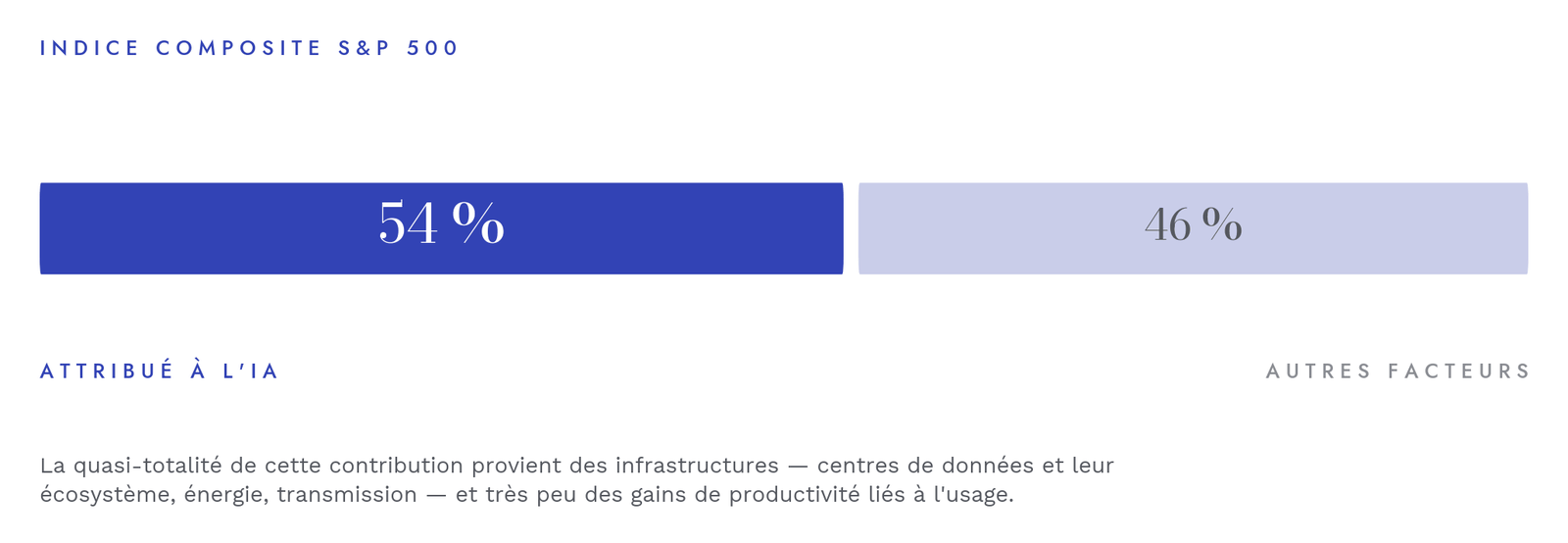
Figure 1 · AI’s contribution to earnings comes from infrastructure, not productivity. Source: Piper Sandler survey of S&P 500 companies.
Inflation, for its part, remains above target for the sixth year in a row, with risks tilted to the upside. New pressures are now adding to the structural factors: persistent tension in the Middle East — which has now taken an acute turn with the Houthis’ threats to control access to the Red Sea and the damage to the Yanbu pipeline, which made it possible to avoid the Strait of Hormuz — and the Russia-Ukraine conflict, combined with the supply shocks caused by extreme summer heat and an exceptional El Niño episode, are weighing on energy and food prices.
At the same time, the global capital spending boom is fuelling pressure on goods prices, while the retirement of the baby boomers and immigration now close to zero are limiting growth in the working-age population. In other words, labour supply is contracting at the very moment that investment demand is taking off.
Added to this is a new political uncertainty. The Democrats appear well placed to retake the House of Representatives, and their chances of winning back the Senate have improved markedly, to close to 50%. Such a configuration could encourage Donald Trump to step up his interventionist policies: higher military spending, protectionism, financial repression, a more aggressive geopolitical stance. Conversely, with a Democratic majority, POTUS’s unpredictability could be contained.
1.2 A negative configuration for bonds
A deficit of close to 6% of GDP, federal debt of around 40,000 billion dollars and a rising interest burden of around 3.3% of GDP — nearly a quarter to a third of government revenue — are fuelling concerns about fiscal sustainability. With several states competing for the same global pool of capital, these imbalances are putting upward pressure on long-term rates and strengthening expectations of possible intervention by the US Treasury.
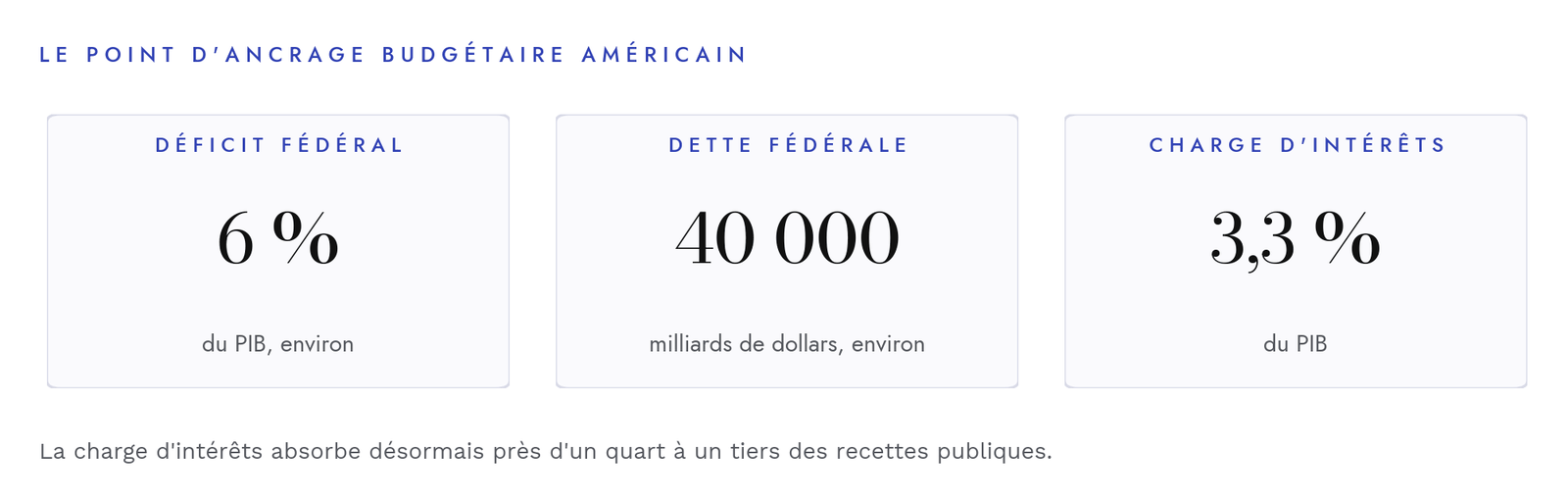
Figure 2 · Three figures that set the course of US long-term rates. Source: US federal budget data, Côme estimates.
Two aggravating factors are added to this. First, Kevin Warsh’s determination to move away from monetary communication based on forward guidance, which should mechanically increase rate volatility: the market must learn to no longer be led by the hand. Second, a challenge to institutional credibility, which reached its apex with the market’s opposite reaction when Bessent tried to artificially push down the US 30-year: in short, the behaviour of central bankers and that of this administration are both tending to push risk premiums up.
This situation is also spreading to Europe and Japan, with a general rise in nominal rates and an unpleasant counterpart for the budgets of all indebted countries in terms of interest expense. So much so that the trade-off with equities, given all the accumulated geopolitical risks, is becoming increasingly rational if signs of easing inflation appear.
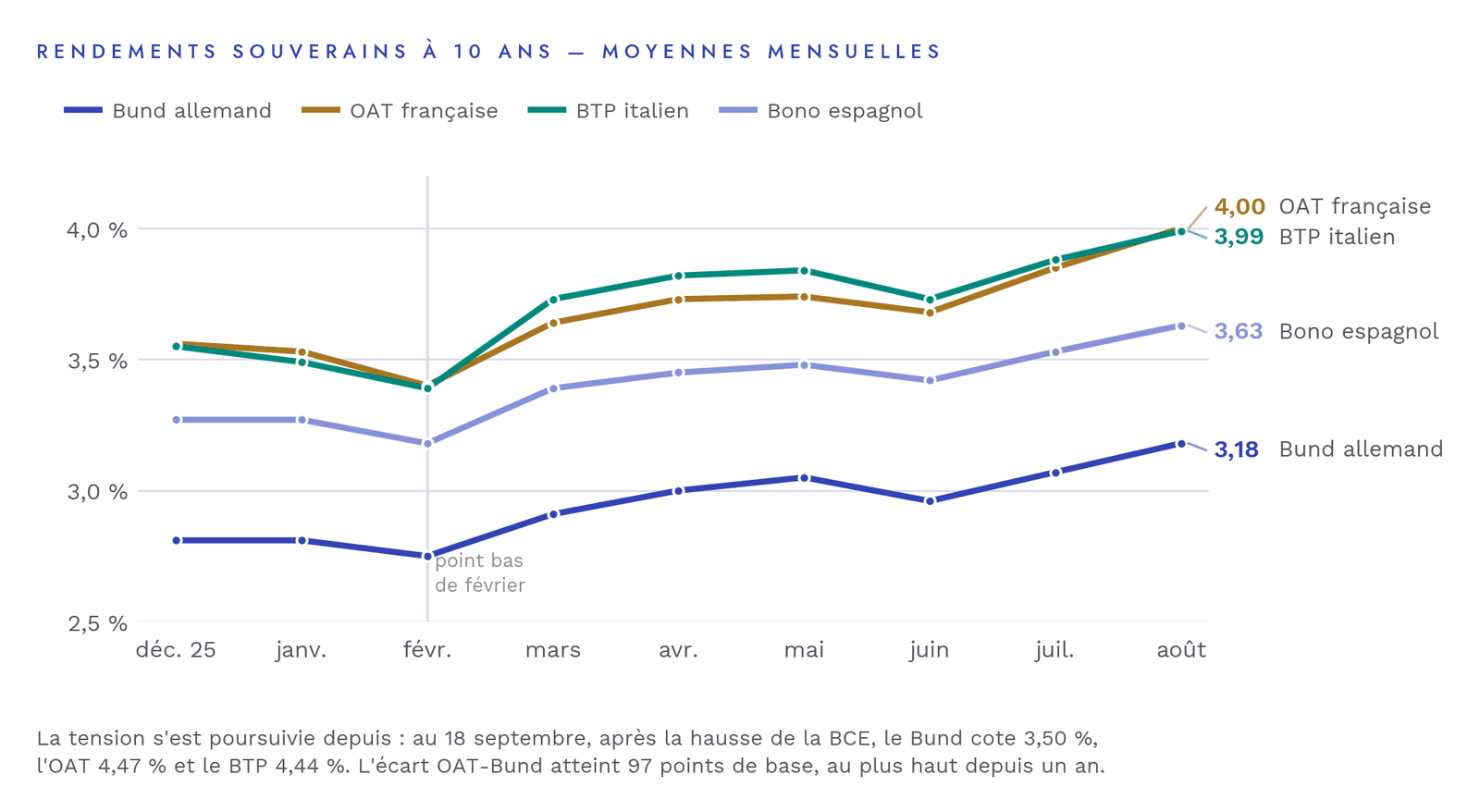
Figure 3 · The repricing of euro area sovereigns since the start of the year. Sources: OECD, monthly long-term rates (FRED series IRLTLT01); daily readings from Banque de France and Deutsche Bundesbank for September.
Why rates are rising*
They are set out in the appendix: they rest on solid real growth, for now coupled with a solid labour market as long as investment is maintained, very high indebtedness combined with lax management (tax giveaways), the extra cost of the war, the Fed’s poor readability, and fewer foreign buyers, put off by the freezing of Russian assets and the possibility of a third power controlling their assets. In addition, some are starting to fear unorthodox moves by the US Treasury to artificially push down 30Y rates, which are at a 19-year high, with an obviously harmful effect on interest expense and on the financing of goods that matter for American dynamism (cars, above all construction).
Howard Marks, one of the most closely followed investors on Wall Street, denounces this practice.
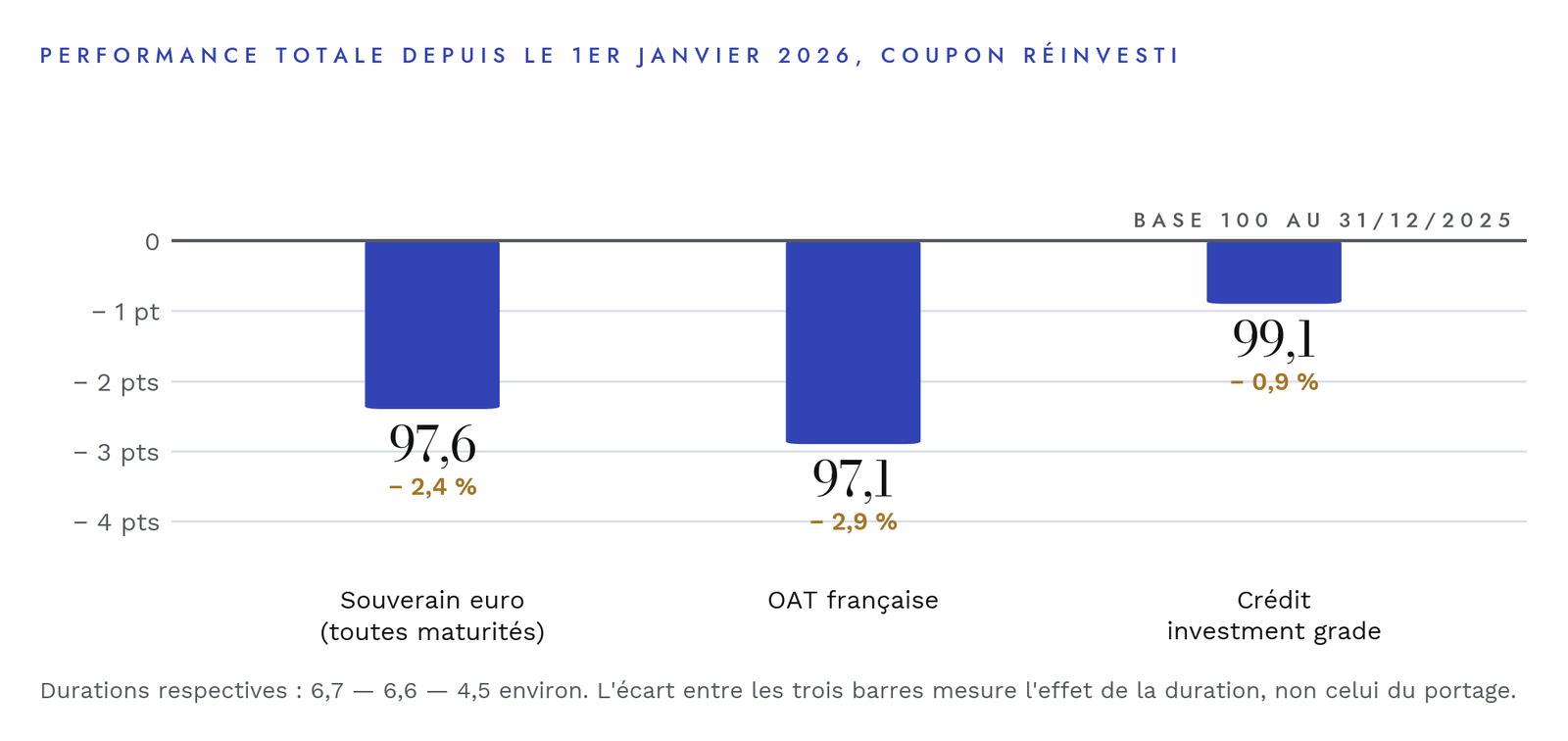
Figure 4 · The coupon no longer absorbs the rate shock. Sources: Bloomberg Euro Treasury, Euro Aggregate Treasury France and Euro Corporate indices, NAV performance as at 10 September 2026.
We therefore maintain low interest-rate sensitivity, with short positions on US and European long-term rates, complemented by exposure to strategies that benefit from a pick-up in inflation.
1.3 US equities: a defensive approach
Beneath the surface of markets that are nonetheless resilient, rotations are violent. Positions that had become highly consensual on AI, momentum and high-beta stocks have gone through several phases of unwinding, while quality stocks have regularly come back to the fore; the two dynamics continue to alternate rapidly. The first threat stems from the very heavy concentration in the technology sector.
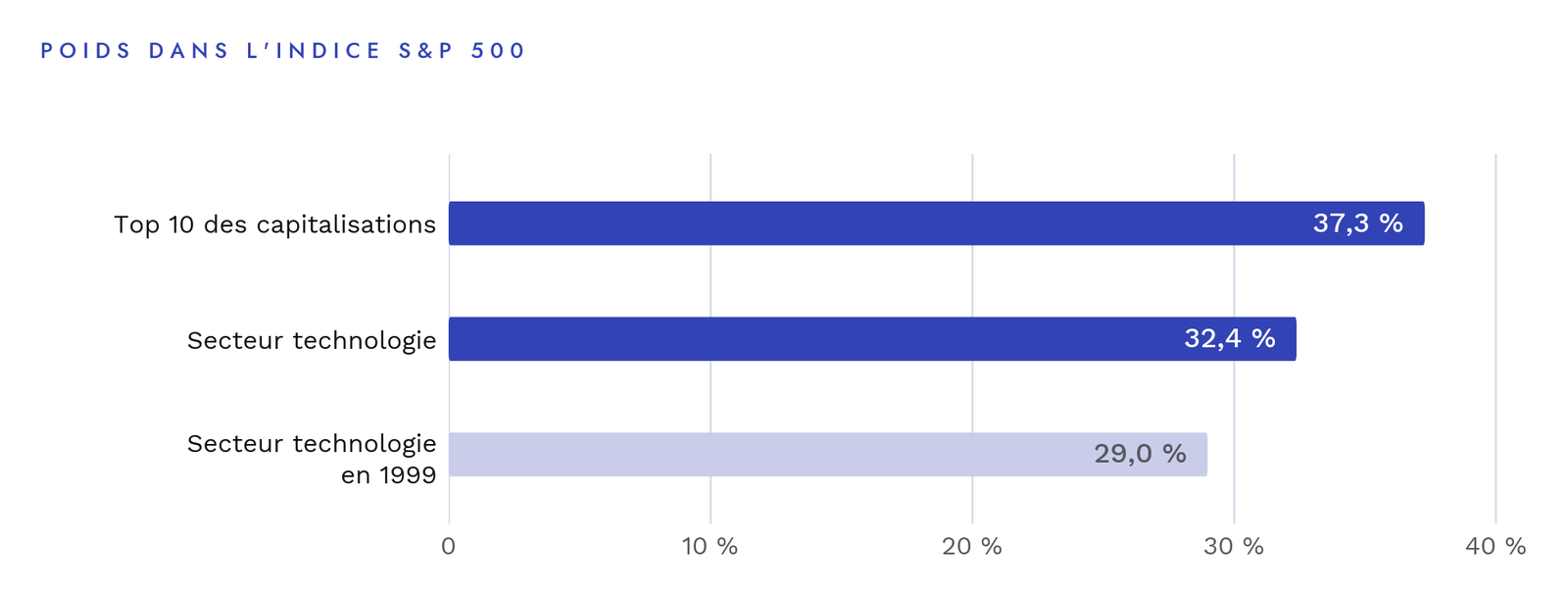
Figure 5 · Index concentration without recent precedent. Sources: S&P Dow Jones index data, 2026 readings; 1999 sector weight for comparison.
The greatest paradox is to set the volatility of the S&P, almost sedated over the summer, against that of TMT (Tech Media Telecom) momentum, closer to a rollercoaster. Goldman Sachs observes that volatility on some of its Tech baskets is 6x more violent than that of the index! Naturally, the correction in TMT momentum was therefore extraordinarily violent in the United States (−50%), but the momentum style in Europe did not come through entirely unscathed (−20%) before resuming its advance over the last few sessions.
Earnings momentum, for its part, remains favourable: expectations for S&P 500 earnings growth in 2026 have risen from around 15% at the end of last year to 29% today, which has so far partly offset the negative impact of rising bond yields and production costs.
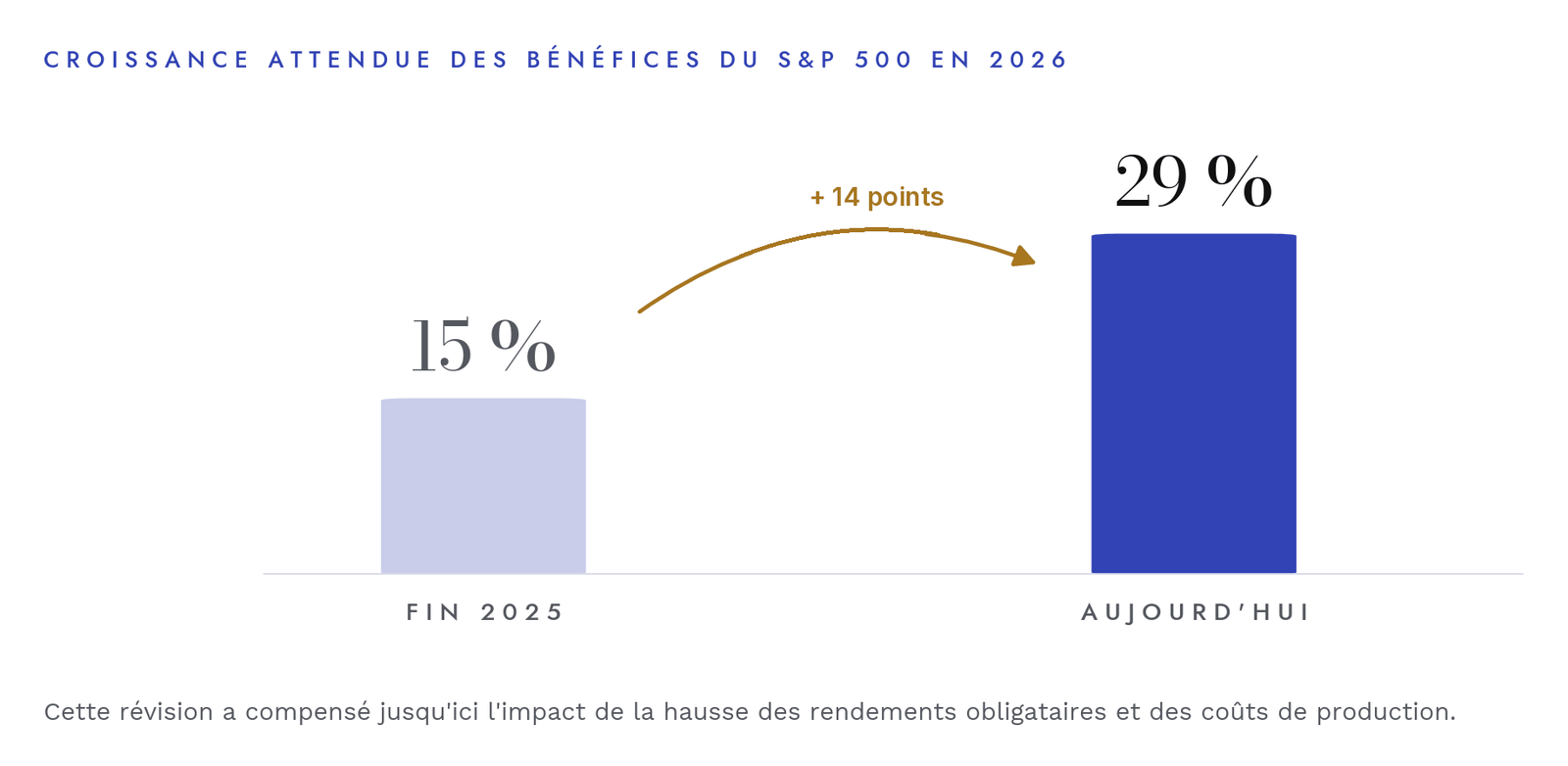
Figure 6 · The revision in earnings expectations has acted as a shock absorber. Source: market consensus, Côme readings.
AI remains at the heart of concerns: markets will seek not only reassurance that investment programmes will continue, but increasingly proof that this spending is actually translating into improved profitability. That is the tipping point to watch — the market has financed the capex, it will now want to see the return. Outside technology, earnings expectations are much less demanding, which creates more upside potential if the improvement in earnings were to broaden.
The strength of nominal growth remains favourable to equities, and low volatility leads us to look at attractive opportunities to back funds that can put hedges in place cheaply. We favour a very defensive strategy: tightly managed exposure to AI, focused on companies that combine growth and durable earnings in a cautious scenario, and quality growth opportunities in healthcare, financials and industrials.
It should be noted that a scenario of a very sharp rise in energy prices would be harder for the European economy, which is a large importer, while the United States, with barely 2% of its energy needs coming from the Middle East, and an energy exporter, will be less affected.
1.4 Europe: resilience endangered by rising energy prices
European growth remains resilient, driven in particular by Germany and Spain, despite persistent supply constraints (particularly on oil and gas) and the consequences of an exceptionally hot summer. Fiscal activism remains a major support: the Merz government’s historic plan is starting to take effect, and NextGenerationEU funds continue to be deployed in the peripheral economies. Domestic demand should remain well oriented, as long as the energy scenario does not become critical, thanks to an acceleration in business investment, while the contribution from foreign trade will remain weak. The downside is that the return of inflationary pressure is forcing the ECB to defend its credibility.
In fixed income, the long maturities of “core” sovereigns remain vulnerable: rising supply, persistent deficits and resilient growth are pushing long-term rates higher. Sovereign spreads look too tight to us; the deterioration in fiscal trajectories is not fully priced in and could cause spreads to widen, particularly in France, where political uncertainty adds a risk factor.
On the other hand, real rates look attractive: at around 1.1% above inflation, they are close to their highest levels in fifteen years, but implied inflation expectations could rise sharply if the situation in the Middle East deteriorates further. In credit, we remain defensive for now: spreads close to their historic lows at index level offer little protection.
In equities, the European case is not just about valuation. Resilient growth and German fiscal support remain supportive, and above all Europe offers real diversification relative to markets largely dominated by AI. Quality stocks continue to trade at relatively depressed levels even though their fundamentals are solid, or even improved: healthcare, industrials, banks. Our exposure remains concentrated on industrials driven by long structural trends: electrification, reindustrialisation, aerospace. Luxury looks at risk to us in the short term, given China’s aggressive tax policy towards the taxation of Chinese assets abroad, which affects one of the important drivers of demand.
1.5 Emerging markets, the relative strengths of young countries: a lighter pension burden, a healthier balance sheet
Emerging economies have absorbed the upheavals of the year. They benefit from stronger fundamentals (inflation broadly under control, contained deficits, credible policies, orthodox central banks), which give them a greater ability to withstand external shocks.
The Asian technology export cycle is particularly buoyant, with exports of semiconductors and equipment reaching record levels, driven by the global roll-out of AI infrastructure; South Korea and Taiwan are at its heart. China, for its part, continues to move at two speeds: domestic consumption and real estate remain fragile (the introduction of very severe tax provisions on assets held abroad is weighing on discretionary demand), while industrial production and exports remain robust, feeding a large trade surplus against a backdrop of renewed trade tensions with Europe and the risk of further US tariff increases. The Xi/Trump meeting could bring a détente, because both sides face economic momentum threatened by rising energy prices, which is unhelpful to the current government ahead of the US midterm elections. It may be wise, at this stage, to bury the hatchet, with China monetising privileged access to Iran by facilitating a possible reopening of the Strait of Hormuz, which would allow it to negotiate access to US technologies and would revive the European customer, particularly weakened by this surge in energy prices. The two great rivals are trading blow for blow in their frantic race towards AI, but must also keep a balance and restore their external and domestic markets. The intense call on the US military, the need to rebuild stocks (munitions and oil), to curb inflation, and the stakes of the midterms give China a strong card to play, beset as it is by a prolonged domestic crisis in real estate and domestic demand, and with an economy that relies on exports: it needs customers in good health.
In India, domestic fundamentals remain solid and growth should continue to outpace that of its peers, but external shocks (oil, a weak rupee) have increased macroeconomic pressures and foreign flows into equities have turned negative. Foreign exchange reserves and targeted government measures provide significant buffers, but the external environment calls for caution in the short term.
In Latin America, fundamentals remain supportive (copper, gold and oil production, electoral shifts in favour of economic liberalism) while the Brazilian presidential election is awaited (the corruption scandals of the current majority could bring the candidate Bolsonaro, not the former president, back into the running, aligned with US positions and more “pro-business”). High real rates, attractive valuations and exposure to commodities, both oil and agriculture, offer selective opportunities.
In equities, the environment remains supportive: prospects of a weaker dollar, expected EPS growth of 24% in 2027 against 12% for the MSCI World, and a valuation discount of around 45% relative to developed markets.
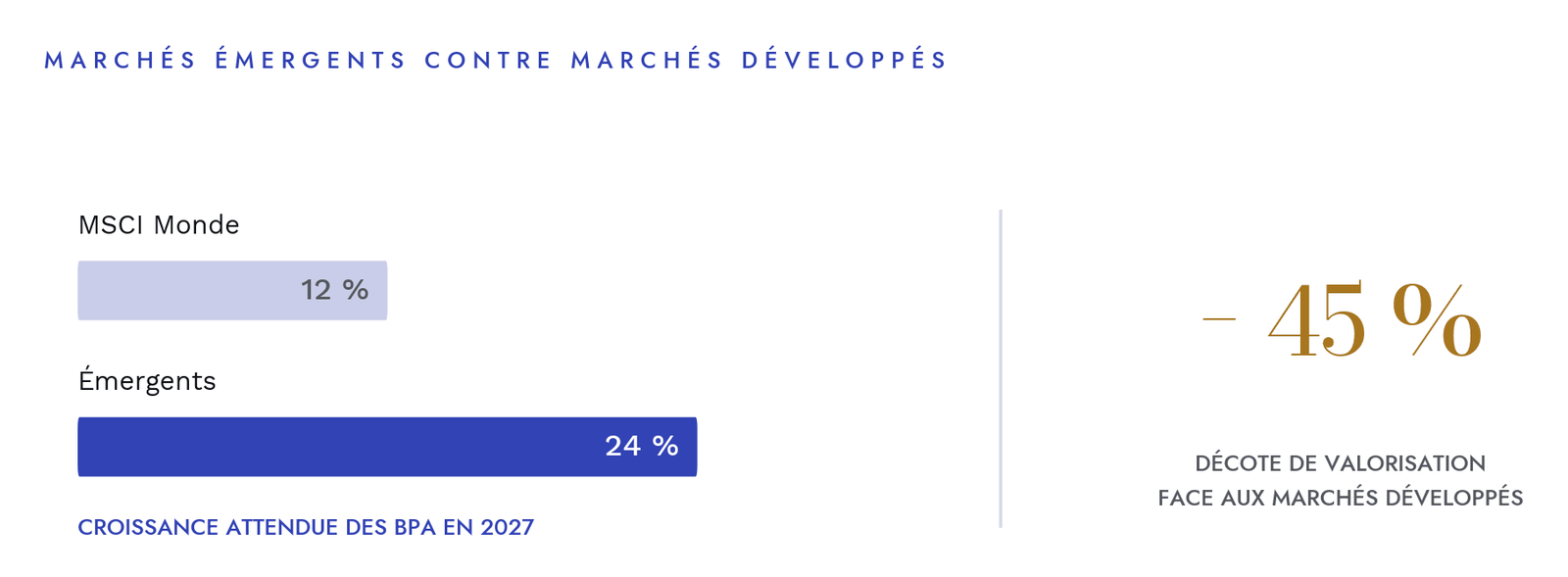
Figure 7 · Emerging markets combine earnings growth and a discount. Source: market consensus, Côme readings.
On the dollar, our view remains negative: the erosion of US credibility should continue to weigh, and we favour the yuan — a massive trade surplus — and the yen, on the unwinding of the carry trade.
PART II · TANGIBLE ASSETS, THE THIRD PILLAR OF THE PORTFOLIO
The sovereign bond sleeve no longer performs the shock-absorbing role attributed to it. Since its correlation with equities turned positive again, the 60/40 portfolio has lost its natural counterweight. That is the role we assign to tangible assets — not as a tactical hedge, but as a structural allocation, so as not to end up in a situation like 2022.
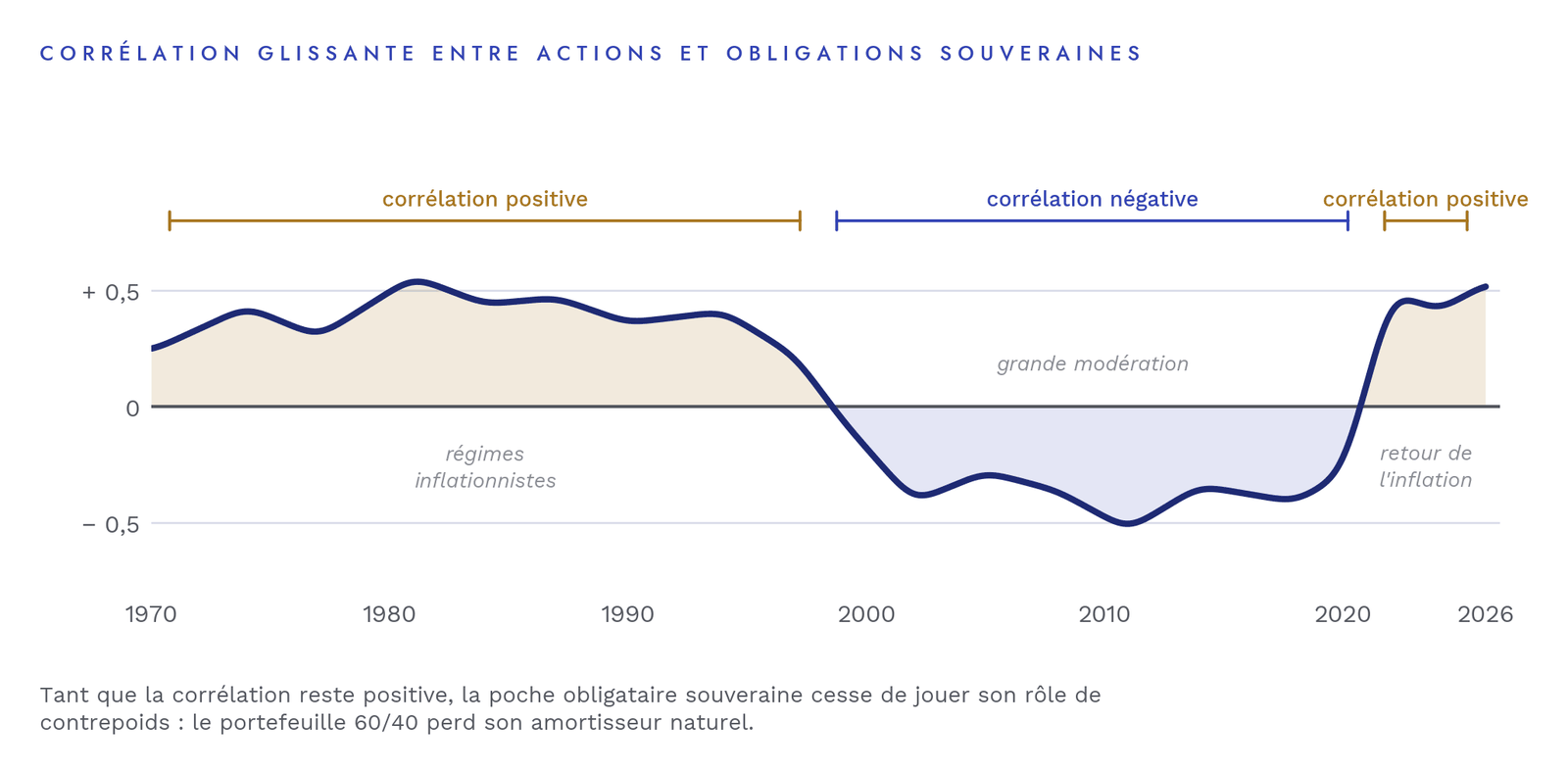
Figure 8 · The equity-bond correlation has changed regime. Schematic chart: the curve shows the sign and sequence of documented correlation regimes, not a calculated series.
We are in a lasting period of positive equity-bond correlation, which most often stems from inflationary shocks. As a result, a 60/40 portfolio cannot deliver the low volatility it is supposed to produce, since higher energy costs affect both economic growth and inflation, and therefore earnings growth and the price of money, with a negative effect on both equities and bonds, especially when over-indebted governments have little room for manoeuvre to protect the main economic agents.
2.1 Gold: a safe haven of monetary security in an inflationary world
Three reasons to hold gold.
The first is the weakness of the dollar, which is as much a matter of economic policy choice as of market movement. A deficit of close to 6% of GDP, federal debt of around 40,000 billion dollars and an interest burden absorbing nearly a quarter to a third of revenue leave only three ways out: austerity, financial repression or depreciation. The first two are impossible before the elections, and hard to carry out with chambers that are likely to be Democratic afterwards. That leaves only depreciation of the dollar. Gold is the mechanical mirror of this trade-off: it is not rising despite the strength of the US economy, it is rising because many economic agents see dollar depreciation as the only way out.
The second is the gradual shift from the petrodollar to the petroyuan, which reflects the inability of the United States to protect the Gulf countries (Saudi Arabia and the Houthis being a latest artefact of this), beyond economic distrust of the dollar, and the relative geopolitical readability of China. The growing settlement of energy flows in yuan and the proliferation of bilateral arrangements outside the dollar weaken the usual channel: the recycling of oil surpluses into US Treasury bills. On the one hand, this removes from the Treasuries market a structural and price-insensitive source of demand; on the other, it pushes trade surpluses to seek an alternative store of value, and gold captures this reallocation because it is the only liquid reserve asset with neither counterparty risk nor jurisdiction.
The third is central bank buying, mainly for reasons of sovereignty: the freezing of foreign exchange reserves in 2022 showed that a third country can seize a dollar asset. That is out of the question for other central banks, particularly in emerging and commodity-exporting economies, which need to invest their surpluses. This changes the nature of the market: to the traditional investment flow, procyclical and sensitive to real rates, is now added a sovereign flow, acyclical and regular, which guarantees structural support.
Gold is rising even though real rates are close to their highest levels in fifteen years, a configuration that is a priori negative. This break in the historical relationship between gold and real rates marks the arrival of sovereign buyers, but also expectations of heavy dollar creation — one of the few ways of managing the scale of US debt. We are keeping significant exposure, either directly through gold ETFs or through mining stocks.
2.2 Agricultural commodities: inflation foretold
So far we have treated inflation through energy, capital goods and the labour market. Agriculture is its third source, most often neglected by allocators because it is seasonal, volatile and considered hard to invest in. Yet it has a valuable property: it is strongly decorrelated from the rest of our portfolio and from the AI cycle, and it behaves favourably in the inflationary scenario. Five forces add up here.
Fertilisers, first, pass on the energy shock with a one-season lag. Ammonia is a natural gas derivative: the strain on European gas prices, which we already identify as a constraint for the ECB, spreads mechanically to the cost of nitrogen inputs. The transmission does not show up immediately in food prices — it works through the fertilisation decisions of the following season, that is, through future yields. A shock to fertilisers today is a shock to cereal supply in twelve to eighteen months, and this lag is almost systematically underestimated.
El Niño then adds a yield risk across many production areas. The exceptional episode we include among the supply shocks weighs on areas that are hard to substitute (South-East Asia, Australia, Latin America) and on crops where a handful of countries set the world price.
The summer drought of 2026 has, moreover, already eroded the balance sheets of some producing countries. The extreme heat suffered in the United States and Europe had an immediate agricultural downside: downward revisions to harvests and delayed rebuilding of stocks. Yet, and this is a very important notion, it is the **level of carry-over stocks**, far more than the year’s harvest, that determines how sensitive prices are to the next shock. Low stocks turn a weather event that could be absorbed within a single harvest into a violent price move.
The intensification of the Russia-Ukraine conflict plays out on two levels. The region accounts for both a decisive share of world exports of wheat, maize and sunflower and, through Russia, a decisive share of the supply of fertilisers and of the gas that produces them. The same conflict therefore weighs simultaneously on the “harvest” part and the “inputs” part of the food price.
Finally, the rise in freight costs has a multiplied effect because of a value-to-weight ratio among the lowest in world trade: transport accounts for a disproportionate share of the delivered price, somewhat as it does for aggregates. Any rise in freight rates, any lengthening of routes due to geopolitical detours, is therefore passed on more strongly to the price paid by the importer than to the price received by the producer. One only has to look at the stellar performance of shipping companies to anticipate a lasting situation of high transport costs (all the more so as many ships will be scrapped before 2030).
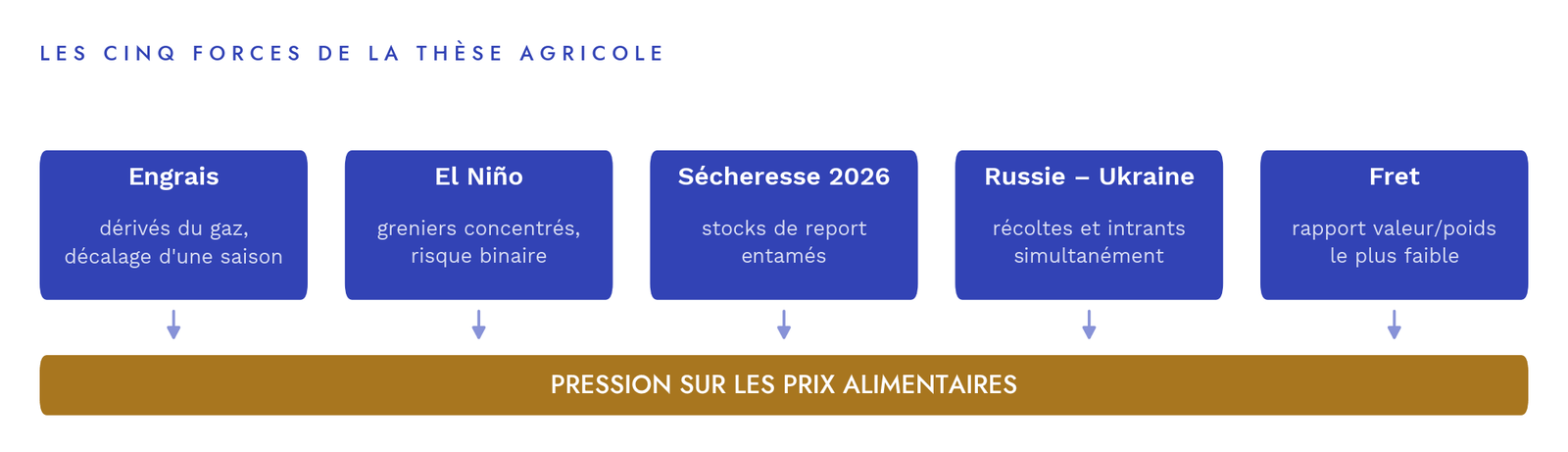
Figure 9 · The five forces driving the agricultural thesis. Analysis: Côme Maison of Finance.
Over a two-year horizon, we are taking the agricultural commodities bet through ETFs and are looking at input producers, agricultural equipment makers and asset holders, also seeking exposure to the currencies of exporting countries. We believe this aspect is very largely undervalued by the market: some fertiliser producers are said to have mothballed plants of their own accord, judging that their customers would not be able to absorb the price increases implied by the cost of their inputs.
PART III · NAVIGATING 2026-2027
3.1 The uncertainties
What if AI profitability disappoints?
The risk is not that investment programmes stop; it lies elsewhere: spending continues but does not translate into demonstrable profitability. Other theses are circulating and call for caution:
– How should the safety of these models be gauged, and should the race therefore be slowed? Is this fear scenario, which would freeze progress where it stands today, not a way for the groups that have invested colossal resources to curb the rise of open models (mainly Chinese)?
– Circular counting? Are the circular flows of activity, in which LLMs, chip makers and all the players become, two steps down the chain, each other’s customers and suppliers, not double or triple counting that overstates the amounts?
– Open source versus closed models? What if the fall in token prices, strongly encouraged by open-source models, were the fatal cocktail for closed LLMs, which need to earn a return to reach a minimum ROCE?
– A collapse in token prices? Is that the way out? Because, with AI delivered at a derisory price, adoption would explode, guaranteeing sufficient revenue and above all enabling massive productivity gains across the whole economy? On this point, a small note of national pride: French companies are the most open to using AI… More seriously, while only China and the United States are tipped to be the winners of this new order, could countries that did not follow the staggering capex arms race not come out ahead, being more productive but not burdened by an effort of unprecedented scale and little profitability?
This scenario would hit earnings, wealth effects and US consumption at the same time — that is, the three pillars of our growth scenario, which are in reality only one.
Strategy. → We favour index hedges over selling positions, as well as funds that would benefit from an increase in volatility. We try not to be exposed to the most concentrated positions. We are looking for bottlenecks.
What if the Democrats win the midterms?
A Democratic House restraining spending, or an administration seeking to reassure bond markets, would ease long-term rates and limit the volatility linked to this administration’s erratic decisions.
Strategy. → his would remove a domestic driver for gold, without affecting the other two (de-dollarisation and central bank buying). Potentially, this reversal would be positive for bipartisan plans aimed at supporting US residential construction, less so for defence stocks.
What if the Iran–United States–Israel conflict is resolved?
As we show in the appendix, there is a wide gap between the dizzying rise in prices we see at the pump and crude oil export volumes, which appear to be back at 2025 levels. Alternative and structural routes have been put in place to bypass the Strait of Hormuz, via the East-West pipeline and via the port of Fujairah. In short, Iran’s bargaining power is diminishing as dependence on the strait fades. This explains Iran’s attempts to mobilise its proxies to prevent Hormuz from being bypassed, and also why the United States now feels it may no longer need to make concessions as broad as it seemed to be considering. In short, also taking into account the damage to the world economy, which affects China, whose growth relies on exports and which has reaped the geopolitical dividends of the US fiasco (a stronger petroyuan, hardly any US missiles left to defend Taiwan), conditions seem to us to be in place for Iran to be increasingly drawn to the negotiating table, by China, its main buyer, or by the simple realisation that its capacity to cause harm is weakening. If so, we will once again be able to move (albeit with a lag due to the physical nature of the flows) into a deflationary world for fossil energy.
Strategy. → This is a risk to the perception of agricultural commodity prices, but a massive positive call for Europe, through expectations of lower inflation and lower rates, favourable for stocks with high energy inputs (including the chemical industry and airlines) and for an explosion in rate-sensitive stocks (concessions, construction, real estate…) around the world.
What if the Russia-Ukraine conflict is resolved?
It would simultaneously lift the risk premium on energy, fertilisers and cereals; in short, it would lead to lower agricultural prices but would have a massive positive impact, mainly on Europe, through lower gas prices and a lower geopolitical risk premium. It would also lead to the perception of a reduced need for defence, but could free up fiscal room to relaunch the continent.
Strategy. → In this scenario, it would be necessary to exit agricultural commodity indices, but to accumulate Europe aggressively, above all its most cyclical stocks. Lower rates and lower energy input costs would very probably lead to an explosion in Central European construction stocks. In this scenario, bets such as Strabag, Saint-Gobain, CRH or Raiffeisen Bank would be big winners.
3.2 Allocation views
**Table 1 · Positioning by asset class**
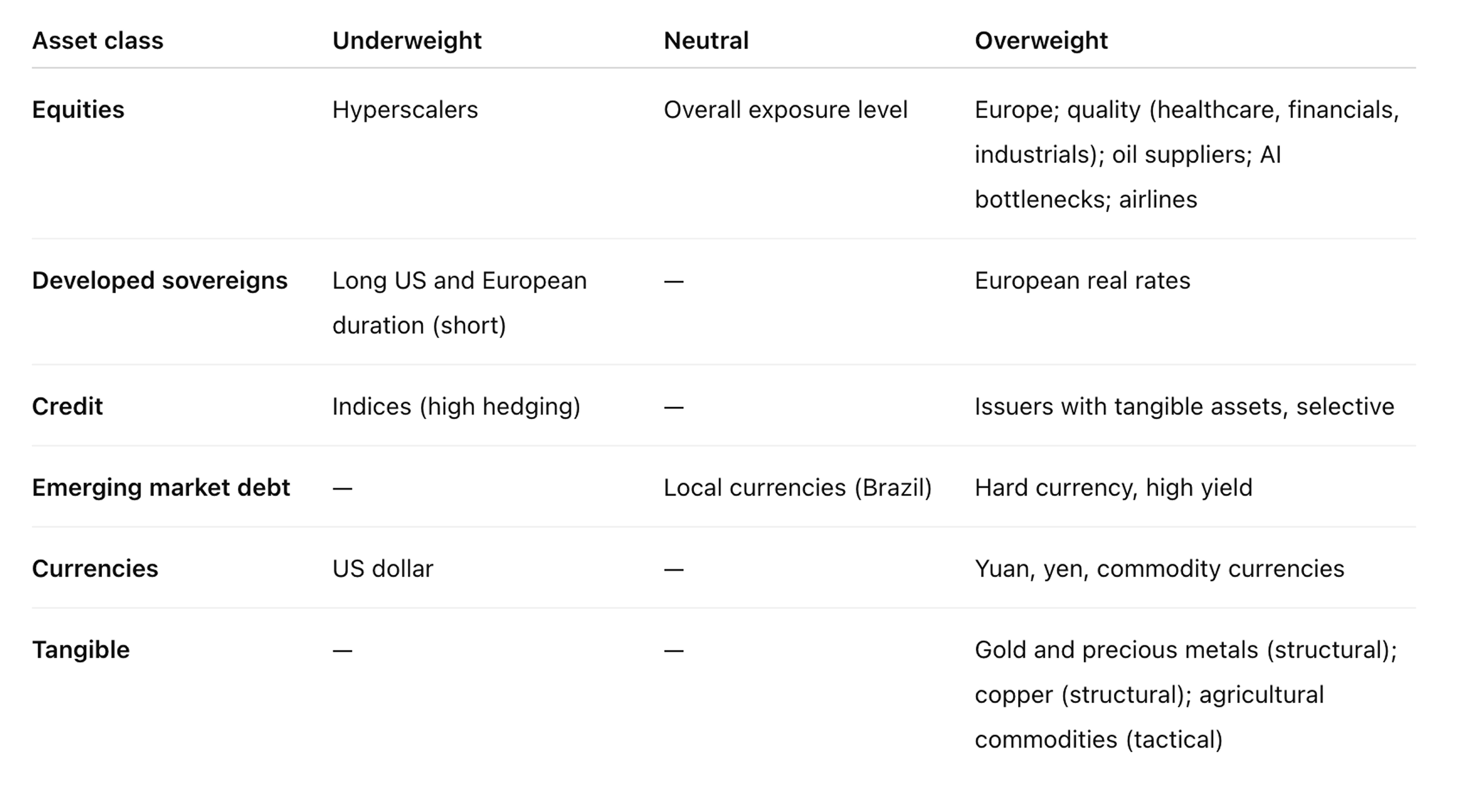
*Positioning relative to the strategic reference allocation, as at 21 September 2026.*
« You can’t print molecules »
Jeff Currie
CONCLUSION
Autumn 2026 confirms the ability of markets to advance on a single engine, but this advance continues with a historic concentration of risk and yet very low levels of volatility: the same bets translate into growth, earnings and wealth effects, and into the inflation that is their lasting flip side, compounded by the exceptional impact of geopolitical tensions.
Our strategy rests on three pillars. Stay invested in equities, because of nominal growth, but defensively and diversifying away from the AI complex — towards Europe, quality and emerging markets. Protect against the interest-rate risks induced by inflationary threats. Finally, rebuild the portfolio’s shock absorber with tangible assets: gold as a structural position, agriculture as a tactical exposure.
We are well aware that this period is particularly difficult to read:
– erratic behaviour from the world’s greatest power — tariffs, trade threats, military aggressiveness;
– very high portfolio concentration;
– exceptional valuations and low volatility on the S&P, very high on Tech;
– very significant and inflationary geopolitical tensions;
– Chinese trade surpluses threatening the European economy;
– hybrid warfare no longer at the gates of Europe, but inside it.
It will be necessary to stay nimble and be prepared for every scenario. To avoid industrial accidents, we consider that we do not want to be exposed to a violent unwinding of AI, but that there are already very interesting opportunities to be exploited outside this highly consensual terrain.
APPENDICES
Why rates are rising
1. Solid real growth, driven by robust capex plans, productivity gains and a resilient labour market.
2. Financing needs higher than expected and a deterioration in short-term fiscal dynamics in the United States. Investors’ growing discomfort on this subject stems from the current administration’s tax largesse; it must also repay its illegal tariff measures, finance a major war effort in the Middle East and rebuild its stocks — munitions and oil — not to mention the shadow cast by colossal private investment in AI.
3. Bond issuance by AI-related companies, which adds to the upward pressure. AI capex is increasingly financed by debt rather than by cash or operating cash flow, which weighs on credit markets as issuers compete for investors’ capital — while raising questions about the return on capital employed, given the persistent threat of Chinese open-source models weighing on prices, the real productivity gains to be expected and suspicions of a circular economy (activity counted several times?).
4. A Fed chaired by Kevin Warsh: less forward guidance, fewer meetings a year, fewer press conferences, but also, given pressure from the US executive, the need to assert its independence: the creature must escape its master so that investors can believe that the institution’s mandate prevails over the will of the appointing body. In our view, this could translate into a higher term premium reflecting greater uncertainty about monetary policy.
5. A change in the Treasuries buyer base: the Fed could shrink its portfolio, with the banking sector and the Treasury itself taking over on the demand side, and with much weaker needs expressed internationally. Schematically, central banks — particularly China — are now buying gold instead of US Treasury bills.
6. High geopolitical uncertainty: war in Iran, the Russia-Ukraine war, tariff disputes. Which brings us back to point 2: more defence spending means a larger deficit.
7. Inflation persistently above the Fed’s mandate in recent years, which is causing divisions within the FOMC. If inflation shows no sign of easing towards its target, this could lead to a more aggressive monetary policy aimed at curbing it and bringing it back towards the 2% objective.
Although most of these factors do not appear to be directly, or mainly, linked to a rise in short-term inflation expectations, we see that some of them contribute to it: point 1 (solid economic growth), point 2 (deteriorating fiscal dynamics) and point 6 (an energy price increase probably greater than we expected, with the recent worsening of the situation in Saudi Arabia following Houthi attacks in the Red Sea and the strikes on the Yanbu pipeline).
A non-consensus idea: almost as much crude oil is now being shipped from the Gulf as in 2025
– After the bombing of the Yanbu pipeline, which allows Saudi Arabia to bypass the Strait of Hormuz and ship its oil westwards via the Red Sea, and the Houthis taking up positions on part of its shores, a critical scenario could have been envisaged, sought by Iran, in which, with its proxies, it would manage to threaten the vast majority of shipments from the Gulf. Iran’s whole calculation is to try to apply maximum pressure before the midterms by driving up oil, and in turn inflation and long-term rates: a planetary economic blackmail aimed at securing the most favourable deal possible.
– But the Gulf countries have constantly adapted so as no longer to depend structurally on this threat: the advent of drone warfare (sic) allows a middle power to stand up to the most powerful navy in the world. Saudi Arabia repaired the pipeline at full speed; the port of Fujairah, in the United Arab Emirates, which have left OPEC, and the stream of vessels easing traffic through the Strait of Hormuz have, against all expectations, almost restored the balance with 2025 flows.
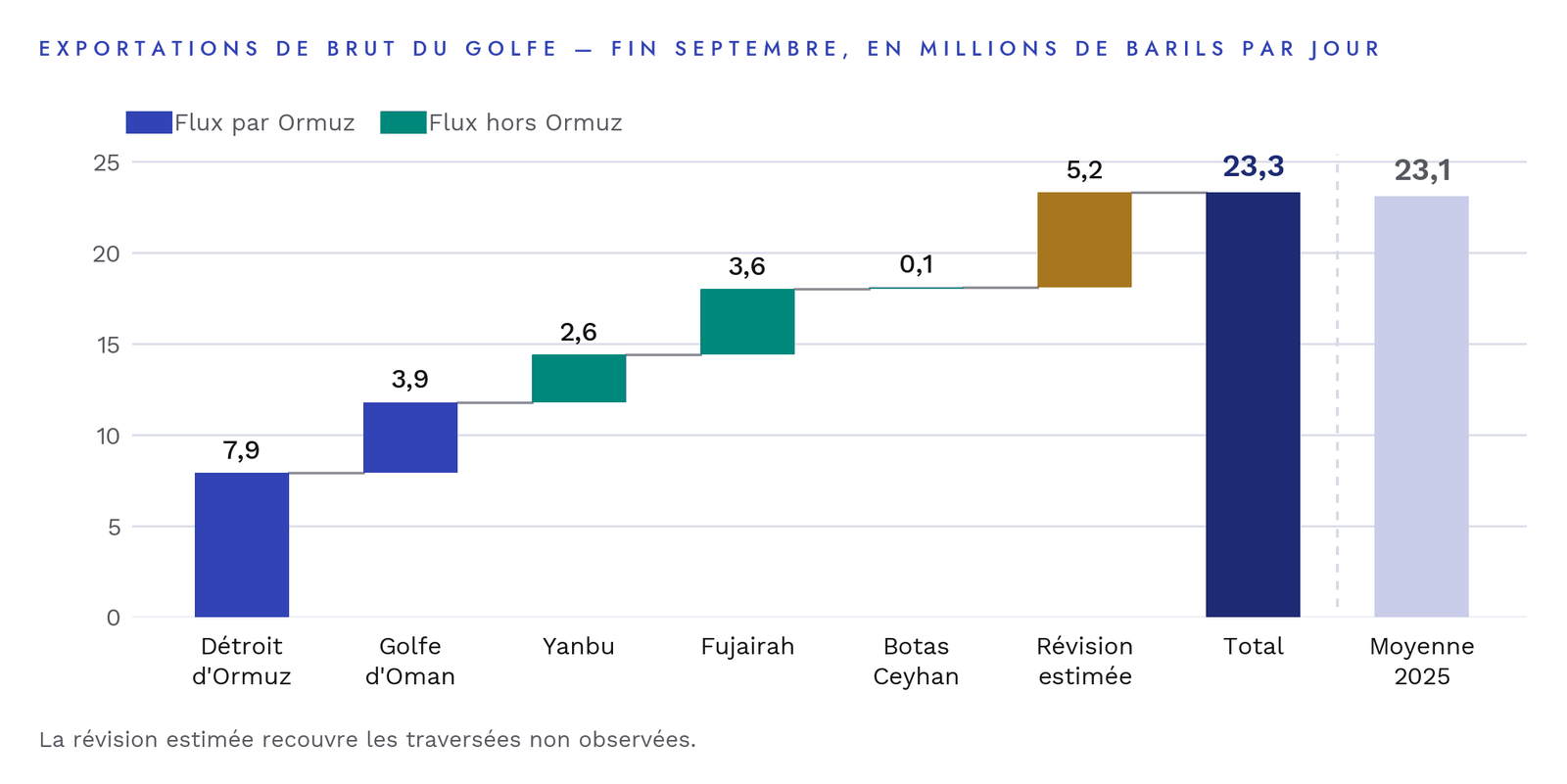
Figure 10 · Gulf crude exports are back at their 2025 level. The estimated revision covers unobserved crossings. Source: Goldman Sachs Global Investment Research, Exhibit 2.
– In short, as this chart shows, it is important to understand that crude oil shipments are almost at their 2025 level, and that Iran’s capacity to cause harm has diminished as the Gulf countries have found alternative delivery routes.
– Diesel prices continue to trade close to their historic highs in the United States and Europe, as the shutdown of the East-West pipeline has further disrupted crude supplies to refineries. But this is above all the result of refining capacity taken off the market by military strikes (Russia, Gulf).
– Gasoline versus diesel: even if spot diesel prices may not yet have peaked — the market is still searching for the price levels needed to bring about lasting reductions in demand —, the initial supply shocks linked to Russia and the Middle East, even before taking into account the effect of prices on refinery yields and on demand, remain disproportionately large for diesel.
– Already, the violence of the price increase (diesel or gasoline) has sharply reduced demand for hydrocarbons and revived demand for electric cars, which in turn feeds the scenario of lower energy prices in the medium term on the back of weaker demand.

The author
Laurent Runacher is Co-Chief Investment Officer of Côme Asset Management. A graduate of ENSAE and an SFAF-certified financial analyst, he worked in the Research department of Crédit National, then at Oddo Securities and Exane..